Introduction
CScrollView comes in handy whenever you need to provide scrolling capability to your view. However, there are several limitations. First, CScrollView is derived from CView, so it is designed to work with the document-view architecture. If you attempt to nest a CScrollView inside a normal CWnd or a CDialog, you will get into a big heap of trouble. If your application requires simple and lightweight scrolling support, CScrollView becomes awkward and costly. Second, the size of the scrolling region is bound to the signed 16-bit limit. Your application may require painting on a large logical area. A map editor or a graphics design application is a good example for such a situation. CScrollWindow was created to address the above problems.
Background
Basing on the MFC source code of CScrollView, I made some modifications to achieve my targets. To avoid creating bugs, I tried to make as few changes as possible. However, I know that I am just as imperfect as CScrollWindow, so bugs may still exist.
Unlike CScrollView, my class CScrollWindow is derived from CWnd so that it can be put inside any other CWnd. If you want it on a view, nest it inside a CView or any derived class. In this way, you can still make CScrollWindow play nicely with the document-view architecture, of cource with more effort than if you use CScrollView. However, flexibility is what you get in exchange for the effort.
CScrollView uses functions LDtoDP and DPtoLP to convert points from device unit to logical unit and vice versa. These functions accept only 16-bit values. Therefore, you get errors when your total width or height is greater than 32767. To avoid these errors, I do not use these functions, which means that CScrollWindow does not support mapping modes. The only supported unit of length is pixel. If you want to support other units of measure or even zooming, you have to implement it on your own, given the background that CScrollWindow provides to you.
One important point is that CScrollView uses 16-bit position data provided by WM_HSCROLL and WM_VSCROLL. CScrollWindow instead calls GetScrollInfo to get 32-bit position data.
Using the Code
Although CScrollWindow works with any CWnd and derivatives, including CDialog, I embed it in a CFrameWnd in the demo project in this article. You would typically add a member of the type CScrollWindow or derivatives in your CFrameWnd.
CScrollWindow m_ScrollWindow;
In the OnCreate of your CFrameWnd, create the scroll window and set the scroll sizes.
if (!m_ScrollWindow.Create(NULL, NULL, AFX_WS_DEFAULT_VIEW,
    CRect(0, 0, 0, 0), this, AFX_IDW_PANE_FIRST, NULL))
{
    TRACE0("Failed to create scroll window\n");
    return -1;
}
m_ScrollWindow.SetScrollSizes(CSize(65536, 65536));
Running the Demo
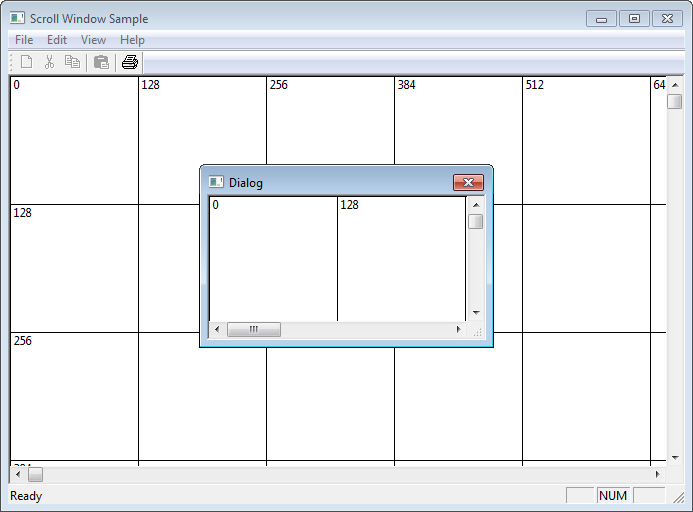
The demo creates a scroll window with a large total size. Scroll around using the scroll bars to verify that you can view any part of the total area.
History
March 23, 2008
- Uploaded the first version
September 12, 2015
- Changed the project name from
ScrollWindowTest to ScrollWindowSample - Converted the project format so that it can be built in Visual Studio 2008
- Removed the
SystemInformation class, thereby simplifying the code - Modified the drawing code in the demo project
- Revised the tip
This member has not yet provided a Biography. Assume it's interesting and varied, and probably something to do with programming.



 General
  News
News  Suggestion
  Question
  Bug
Bug  Answer
  Joke
Joke  Praise
  Rant
Rant  Admin
Admin 


 Submit an article or tip


