Introduction
I have looked around a lot and decided that the majority of "standards" for databases don't make sense, so I thought I would document mine.
Background
Looking around at the standards on the internet, I see that there are suggestions like, use the prefix tbl for a table name, and col for column
names, use the table name for the primary column name, and they are silly. It gets worse when people start prefixing column names. The worst one I saw was
cusCustomerNotes for a string in their customer table. So I am going to put forward my philosophy and explain each one.
Natural joins are evil
I start here, because my next point will be argued to no end if I don't. One of the most nonsensical arguments I hear is that columns should be uniquely named,
that way your tool "knows" the proper join without you having to do an explicit join. Thus the tool, like Enterprise Manager, or in the case of Oracle, the SQL Execution Engine,
will explicitly or implicitly create the join for you.
If you don't know what a natural join is, the simple description is "you can be lazy and not write your join because the database knows what you mean".
So SQL like the following actually works (doesn't even complain in Oracle).
SELECT person.*,card.* from person, card
The obvious problem here is that you have no idea what is being joined on social security number, person, who knows... Furthermore, you have no idea if it
is supposed to be an inner join (as a natural join is), or if it is a cross join. A cross join joins all the rows from both tables.
A secondary problem is that different database systems will treat the statement differently, some treat it as a cross join, others treat it as a natural join.
It is my experience that all joins should be explicit and laid out as joins. The following clearly indicates what is intended:
SELECT person.*, card.*
FROM person
INNER JOIN card
    ON card.person_id = person.person_id
If I had designed the tables, it would look like the following instead. (Note the id column in the Person table is now just id
rather than person_id), so a natural join won't work. However, tools like Enterprise Manager will recognize the foreign key relationship.
This is assuming that one exists, and it absolutely needs to if you want to make sure of your data integrity.
SELECT person.*, card.*
FROM person
INNER JOIN card
    ON card.person_id = person.id
I dislike implicit joins in the where clause for one very simple reason, you then miss joins, thus you end up with natural and cross joins. On complex queries
like the following, you could very easily make a mistake.
select country.countryname, state.statename, county.countyname, city.cityname
FROM country, state, county, city
WHERE state.country=country.country and city.county=county.county
At a very minimum, in this example, state and county are a natural join or cross join depending on whether or not there is a matching column name, but we don't know,
so who knows what data this will return.
In my opinion, it is better to be specific so that the compiler knows what you want rather than making it guess.
Reuse column names
Why would I ever want to make unique names for every table; for simple things, if a column is the unique row ID, then it should probably called ID;
if it is for a description it should probably be called Description. This way when accessing the table or using it for something like a dropdown list,
it will always be the same SQL. Consistency is the name of the game; if you always name the column representing the name "Name", it will be much easier
to deal with than colcustblCustomerNameString. If we stop and think about it, we already know the table name, so why include it in the name of the column?
Furthermore, databases aren't there only to hold data, some program is out there using it, so more modern program might even be able to use mapping tools called Object
Relational Mappers, and naming consistency helps everything.
Every table gets a row identifier
There is nothing worse than trying to enforce database constraints when the tables are joined against multiple columns for a single entity when the parent row
has a compound key. Here is our state, county, and city example when things get crazy..
SELECT Country.CountryName, State.StateName, County.CountyName
    FROM Country
    INNER JOIN State
        ON State.CountryName = Country.CountryName
    INNER JOIN County
        ON County.StateName = State.StateName
        AND County.CountryName = State.CountryName
        AND County.CountryName = Country.CountryName
As you can see, that gets carried away in a big hurry, and admittedly, this is bad example for a Select statement, since all the information is in the county table.
However, many databases don't support multiple column foreign key constraints, so imagine what happens when someone types the wrong county name when entering a county.
By each and every table having a unique row identifier, it allows you to reference that row for integrity with foreign keys and simplifies those joins in your SQL.
SELECT Country.Name as Country, State.Name as State, County.Name  as County
    FROM Country
    INNER JOIN State
        ON State.Country_ID = Country.ID
    INNER JOIN County
        ON County.State_ID = State.ID
As you can see, it simplifies the SQL as well. Before I leave this subject, I'd like to touch on GUIDs vs. other keys.
Unique Identifiers and Primary Keys
There is a lot of arguments about whether or not GUIDs make useful primary keys. I think the point is being missed, GUIDs are supposed to be unique identifiers,
this is not to say that they should be used for the primary key, because then clustering (organization of the rows in the actual file system) would be meaningless, and thus
performance will degrade horribly. These GUIDs should be used as a unique row identifier, and in some cases, they are required for synchronization technologies.
A very common complaint about GUIDs is that they are hard to remember. Yes that is true, which is why they should never be used as the primary key; the thing
that makes the row unique should be the primary key. Ideally, human meaningful data so humans can look at it. But when enforcing constraints at the database level,
especially in relationships, it is nice to know that you can not put the wrong data into a column. Take a look at the following entity relationship diagram:
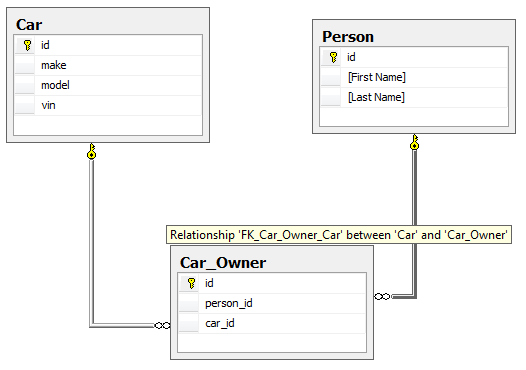
Looking at this, we see that foreign key relationships have been put on the tables, so as far as the database can tell, a row will be valid as long as a row with the
correct number exists in the parent tables. But if we realize that they are just integers, a bug in a program, a cut and paste error, or typo in a Stored
Procedure could flip that data around. inserting the numbers from the person table into the "car_id" column and the numbers from the car table into
the "person_id" column. Depending on the number of rows in each table, it may be a very long time before the error is caught, and then all the data has
to be re-entered. Thus, just because you have a foreign key, that alone doesn't guarantee valid data. However, if the ID columns are indeed GUIDs,
the chances of such mistakes are minimized to the point of virtual non-existence.
In other words, this SQL is much more likely to be wrong and not caught:
INSERT INTO Car_Owner (person_id, car_id) VALUES (3, 5)
Than this one is:
INSERT INTO Car_Owner (person_id, car_id)

VALUES ('{E1D56D43-4FCA-44B1-8D16-BF7F106D0A6D}',

'{BCFB7934-6FB2-4AC1-96BC-1D8D46C7067D}')
Primary Keys should be on the unique data for the row
Two part thought here, first, GUIDs aren't meaningful to humans, you should not need to know the GUID for day to day use of your data. They are for data integrity,
not for use by people. Second, when looking for data, the database needs to be able to find that data easily. So you should never make a person table's
unique key, the GUID, you would make it something unique about them, perhaps their social security number, with a secondary non-unique index on their last, middle,
and first names. The problem with using the name as the primary key is names like John Smith aren't unique, however that will likely be a common search item, hence the non-unique index.
Columns that reference other tables
When a table needs to reference an existing row in another table, it should follow a few rules:
- Such columns should only reference the row ID column
- The reference should be enforced with a foreign key constraint
- It should include the table name
Touching on each point individually, I will start with the first one. A table should contain unique data, that is the reason for its existence. There are
two rows in the table with the exact same data, you have a problem, however the row might be associating two other tables, like my Car_Owner table above.
If I have a table that now needs to reference that table, I don't want to keep that relationship in another place, and I want to make sure that the relationship exists.
So rather than keeping two columns in my new table, I would simply keep the ID column from Car_Owner, or as another example, I wouldn't want
to keep the County, State, and Country, columns in my City table, when I can keep the single column of County_ID
in the City table.
For the second point, it's fairly simple, we tell the database to ensure that the data we are referencing actually exists.
Lastly, including the table name ensures consistency. I know that if I have a column named Person_ID that it is going to be the ID column from
the Person table.
Relationship tables should only join two tables
All too often, people will try to force multiple relationships into a single table. For example, look at the following image:

From this relationship, you can't tell how this relationship is supposed to be, or that the other relationships, like a user belonging to one or multiple groups
actually exist. If the relationship where defined two at a time, you could tell if this table where associating medias to groups of users,
or groups of media to users, or what. The associations would also be guaranteed to exist before making the next
association. For example, in a car lease contract for a corporation, you would want to make sure the contract and corporation exist, before you start assigning cars to it.
Use schema/namespaces to separate like named objects
In the old days, or when using weak databases, you would have to resort to naming your object differently to be able to tell apart a State (a plot of land)
from a State (where in a workflow your process is). So you would end up naming one WorkFlowState and the other State, which is fine,
but modern databases can partition the two objects into separate blocks. Some databases call these blocks "schemas", some call them "namespaces",
while MySQL seems to think they are separate databases. For the most part, the partitioning of these objects into namespaces is conceptually no different than making objects
in your program use different namespaces. Your query will have to be specific, but it doesn't prevent the object from being used.
Fear of keywords
As you can tell, I am not afraid of using words for column and table names that might be keywords. Most modern databases give you some way to handle escaping keywords
so you can use them as things like column names. SQL92, which should have been adhered to by all database now, specifies the double quote ( " ) character to do this.
Microsoft SQL Server uses square brackets ( [] ) to do it, and if QUOTED_IDENTIFIER ON is specified, it allows double quotes. MySQL uses,
of all things, the accent grave (`).
For all you .NET coders, the DataProviders give you the characters if you know where to look.
Make full use of your database
Strongly type your data
Just like in programming, there are different types to do different things, use the proper type for the job. In other words, strongly type your data.
- Use a
boolean or bit to hold true/false values - Don't use character fields to hold numbers
- Make sure number fields have constraints for valid values
- Only use
char/nchar fields when the data is truly fixed length
Just like in programming, these types not only help you keep the data available efficiently, but they help enforce the integrity of the data. Using fixed length
character fields to hold variable length data is a personal peeve of mine. Because if the data isn't as long as the field, the database pads it, requiring
the programming to trim the padding everywhere.
Use Cascades, Triggers, and Constraints
Cascades make sure that when you delete or update a row, rows that depend on it are deleted or changed as well.
Triggers can help make sure that calculations get run when data is updated.
Constraints on fields can make sure of things like "this field must be a positive number". The thing to be aware of though is use of this to enforce
"magic values", i.e., "this field must be a 'P', 'Q' or 'Z'": that is a sure sign that it really should be a foreign key to a table,
so you can display it to the user.
Avoid overloading fields
Don't use a field to indicate one thing, say price, in one circumstance, and another thing, say discount percentage, in another. It makes writing both SQL and code
against the database nightmarish.
Bringing it all together
As you can tell, when I make a table that represents relationships between multiple tables, my best thought is to name the table the table names that it is joining,
separated by an underscore. Even in databases (or database settings) that support differentiating by case only, I don't want confusion between multi-word table
names and relationship table names; for example, I don't want User_Groups to be confused with UserGroups.
These guidelines mean you can normalize your data in a meaningful way, ensuring data integrity.
At this point, someone is going to whine about the performance of normalized databases versus non-normalized databases, and someone else will join in about how GUIDs are
big and slow. Think about this though, the data in your database is likely of paramount importance, are you willing to sacrifice a small amount of speed to
be guaranteed the integrity of your data, or are you willing to go down the route of super high performance and possibly have your data trashed? If you really
stop and think about it, normalization can enhance performance by allowing updates to every user in a group by simply changing the group record, rather than having
to change every user row as you would in a non-normalized database.
Using consistent naming means I can save time in writing SQL, because I know what things will be named, and joins will be easy and consistently fast.
Furthermore, if a well written Object Relational Mapper is used, I might be able to take advantage of inheritance in the programming model.
So as a final example, here is a normalized database example using Country, State, County, and City, and relationship tables. It may be over-normalized, but it means
there will only be one record per name, things like populations, zip codes etc. could be added to the relationship records where they are meaningful. However, this
is a nice academic example but it isn't worthwhile for a business example; because of Consolidated City
Counties, cities like St. Louis Missouri, which does not exist within any county, and because of Washington D.C. which doesn't exist within any state.
However, it does account for a city named Springfield in every state, with no data duplication.
SELECT
        Country.Name as Country, State.Name AS State, County.Name AS County, City.Name AS City
    FROM   Country
    INNER JOIN Country_State
        ON Country.ID = Country_State.Country_ID
    INNER JOIN State
        ON Country_State.State_ID = State.ID
    INNER JOIN  State_County
        ON Country_State.ID = State_County.Country_State_ID
    INNER JOIN  County
        ON State_County.County_ID = County.ID
    INNER JOIN County_City
        ON State_County.ID = County_City.State_County_ID
    INNER JOIN City
        ON County_City.City_ID = City.ID
Gotchas
Like any other ideas on designing databases, there are things that could cause problems. People depending on natural joins is a big one, and I addressed that issue above.
The only real problem I have run into is trying to use Entity Framework with this design. While I haven't tried version 4 with this design, version 3.5 has
a very serious problem even when using SQL Server. EntityFramework doesn't seem to pick up the relationships for foreign keys unless they are against the primary key;
this bug forced me to create a clustered unique constraint on a Name column and make my ID column a primary key.
Things for next time
I haven't touched on several items, like naming Views or Stored Procedures. Nor did I touch on writing SQL too much, I tried to keep it to just the SQL necessary
to explain the choices I have made. Remember to let me know what you think of my articles by voting.
This member has not yet provided a Biography. Assume it's interesting and varied, and probably something to do with programming.



 General
  News
News  Suggestion
  Question
  Bug
Bug  Answer
  Joke
Joke  Praise
  Rant
Rant  Admin
Admin 


 Submit an article or tip


